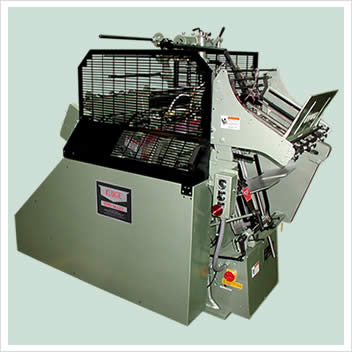
EHD Series (14 x 22)
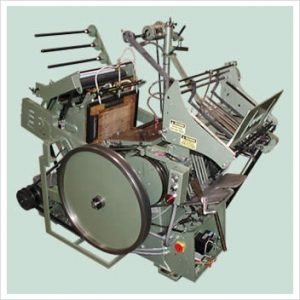
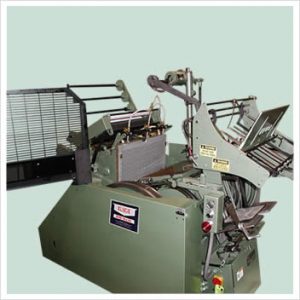
Often called “the workhorse of the industry”, the Kluge EHD is already a legend. Featuring speeds up to 3,300 impressions per hour, the EHD now comes with delayed delivery allowing it to accommodate sheets up to 17″x 24.75″ (431mm x 628mm), with up to 40 square inches of die area. Kluge’s patented Delayed Dwell technology allows the EHD to start on impression sooner, bottom out, and remain on impression longer doubling impression time with no loss of production speed and assuring flawless foil separation from the stock. A new, optional, freestanding mobile electronics console puts all press operations in one place for easy access. The same console can also serve as a workstation and toolbox.
Rugged, dependable and simple to operate, the EHD is known for providing years of reliable service in foil stamping, embossing and die cutting, and for over 25 years has been the standard by which all presses in its class are measured.
All Kluge presses can be supplied with the electrical specification of your country.
Standard
- With vacuum operated feed arm for smooth feeding of a wide range of stock types and thicknesses
- Delayed Delivery – Allows stock greater than 14″ to be run on the EHD
- Mechanical Foil Control System - Allows for a wide array of foil draw and coverage with highly accurate registration between imagesBenefits
- Three-draw system
- Air blast system
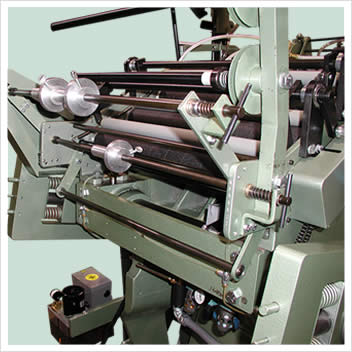
Outline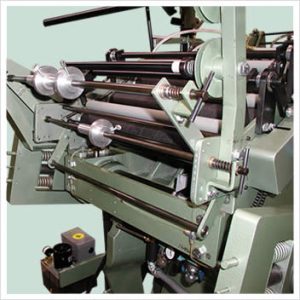 The press comes equipped with a three-draw mechanical foil control system (MFCS) as standard. This configuration allows for a wide array of foil draw and coverage with highly accurate registration between images. All Kluge foil control systems utilize an air blast system to assure the foil relay from stock between impression.
 - Micro Adjustable Gauge Band – Precisely adjust the gauge band for sheet placement
- Delivery - With receding stacker table. Will not mar stock and gives the operator accurate press usageBenefits
- Four-finger delivery arm
- Receding pile delivery table
Outline
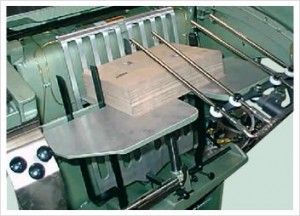 The Kluge delivery system utilizes a four-finger delivery arm operating on a straight-out motion. Combined with a receding pile delivery table and impression counter, the Kluge EHD will not mar stock and gives the operator accurate press usage.
- Feed Without Impression Control – Allows setup of feed and delivery without risking valuable dies and wasting expensive foil
- Impression counter – Will only count the number of impressins for easy totalling of completed stock
- Rotary Vacuum Pump – Allows independent control of the delivery vacuum
- Auto Lubrication System – Provides hands off worry free lubrication of critical press bearings
- Three-Nozzle Air Blast Foil Release – Separates foil web from the stock for improved product quality and increased productivity (requires separate compressor or air system)
- Complete Guarding with Electric Interlock System – Meets rigorous safety standards yet provides access to press
Options
- Hologram Registration Unit - Provides the technology for registering holograms on the EHD
Since the early 1980’s when hologram technology progressed to foil stamping machines, the use for holograms has become more and more wide spread.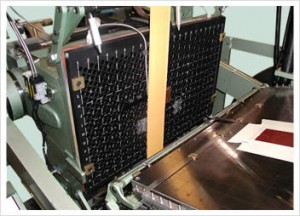 Today the hologram has a whole range of uses from security tags to packaging, book covers and advertising. The video here demonstrates registering a hologram as part of a seven pass colorful foil/hologram display card. Read on to learn more about Kluge’s hologram registration technology and capabilities.The Kluge Hologram Registration Unit is built onto the Electronic Foil Control System, Low Mount. It enables you to accurately register holograms using your Kluge press. Note: the hologram registration unit is not compatible with the mechanical foil control system.
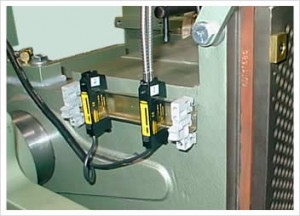 The Hologram Registration Unit utilizes fiber optic technology as the hologram registration mark detection system. The fiber optic sensor is mounted to the toggle base in line with the edge of the foil. The sensor is connected to the signal pick up device, also known as the ‘amplifier’ which is then electronically adjusted until the registration mark can be seen. This innovative system allows you to digitally align hologram foil on the die with registration accuracy of +/- .012″.
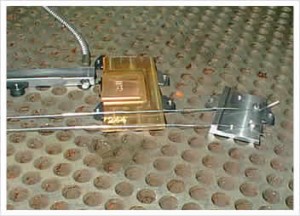 Two #30 gauge wire guides are positioned on the toggle base just below the die, one is placed under the foil and the other is placed over the foil. These wire guides effectively prevent the hologram foil from curling as it is fed through the machine (see photo).Easy access to the configuration and controls of the Hologram Registration Unit is made available from the touch screen control system.Kluge has developed a “User Guide to Hologram Stamping”. Click here to download your free copy and learn about everything from history, to foil types to the technology involved in producing quality holograms.
- Adjustable Impression - Decrease make-ready time. Impression can now be infinitely adjusted with the simple turn of a handle
Benefits- Decrease make-ready time
- Reduce production costs
- Infinite impression adjustment
Outline
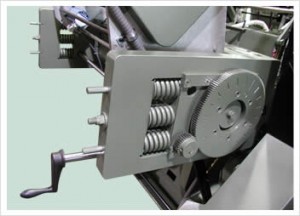 Until now, adjusting the platen bolts and/or adding packing behind the make-ready plate has been the make-ready process for impression adjustments on Kluge presses. Adjustments to the platen bolts are cumbersome and time consuming. Each bolt has to be adjusted equally to maintain as close to level as possible. Because of the inherent design, when raising the platen to increase pressure the platen is put out of parallel with the bed slightly creating more pressure toward the bottom of the platen.
Adding packing is limited by the various thicknesses of the available packing and therefore not infinitely adjustable. When adding spot packing, the carrier sheet used would increase the impression to the whole image as well as the spot. In short this make-ready procedure is very time consuming and requires much skill.
The new adjustable impression design works on the principle of adjusting the impression by shortening or lengthening the side arms. The adjustment is made by simply turning a crank handle and both side arms are simultaneously adjusted equally. Total adjustment is .144″ (just over 1/8 inch) and equals12 flats or 2 revolutions of the platen screws. The adjustment is infinitely variable and not in steps as is packing. Parallel of the platen to the bed is not affected. Of course, spot packing will still be necessary but the affect it may have on the rest of the image will be easily rectified by backing off the impression with the adjustable impression. If, while running a job, the impression diminishes a simple turn of the handle gets you back in business.
This new design has been coupled with a recently released new dwell side arm design. This new patented design offers a longer dwell time at a higher dwell impression than the previous design resulting in more foil coverage and higher production speeds on many products. In addition, the simple switch of this design from dwell to non-dwell operation will save time and greatly increase the use of the dwell feature. The design incorporates spherical bearings at the back shaft, which are more forgiving and, therefore, will offer longer life.
In short, this new development will greatly decrease make-ready time, take much of the required skill out of the press operation and will result in reducing the costs associated with both of these production challenges.
- Preload Magazine - Allows you to reload the press with new stock while the press is running
Benefits- Increase production speeds
- Reload while the press is running
Outline
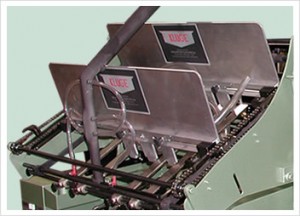 The preload magazine allows you to reload the press with new stock while the press is running, therefore less down time and higher production speeds. Perfect for long runs such as greeting cards or book covers.
- Electronic Foil Control System - Increased impression accuracy when foil stamping
Benefits- Easier to operate
- Less foil reloads
- Greater image stamp accuracy
- Touch screen control
Outline
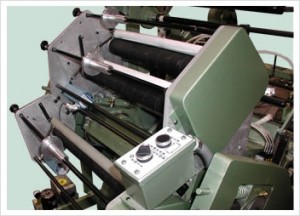 Designed to be even more operator-friendly by making the foil unwind and rewind shafts more accessible to the operator.
The unwind and rewind shafts are staggered, making it easier to observe the unit while in operation. The foil unwind shafts are designed to accept 7 inch diameter foil rolls for longer runs between foil reloads. In addition, the mounting system for the unwind shafts has been strengthened to minimize the shake that naturally occurs from the action of the press.
From the beginning, the accuracy of the gap, between image stamps on the foil, has been the number one goal of the Kluge Electronic Foil Control Systems. Greater accuracy allows for maximum foil savings without worry of a bad sheet. This new unit incorporates a stepper motor control system that can control motion to within .001″. This allows the unit to hold a tolerance as close as +/- .016 ” at the foil gap making the potential for a quick payback through foil savings a reality.
Is available with (up to) four separate draws – each capable of alternating the sequence operation.
Additional draws (up to a total of four) can be added in the field.
An optional foil seam skipper feature is available for non-registered holograms. The foil seam skipper ensures that the seam is never stamped on the product and is successful in doing so with minimal waste.
Unlike some other foil control systems on the market, each foil draw includes it’s own separate rewind shaft.
A foil detector is available, as an option, which stops the press when the foil runs out. This allows the operator the time to attend to other important details.
A friendly and contamination-resistant touch screen achieves operator interface. It is available in inches or millimeters and English or Spanish. The touch screen control can be located in the operator side swing guard or in a movable control console that includes tool drawers and a work surface.
This unit comes standard with storage memory of 25 separate foil draw lengths for recurring jobs. The press operator can simply call up, by number, a previous run job. Or, if a previous job was similar, it can be called up and modified, thus saving valuable set-up time in either case.
- Variable Speed Control – Control press speed with greater accuracy
- Filler Plate – Replacement for die heating plate when die cutting
- Missed Sheet Detector – Prevents die, make-ready and press damage
- Foil Detector – Stops the press when a roll of foil is empty
- Lightweight Grid-etched Toggle Base - Gridded construction for greater accuracy in the die make-ready and weighs only 14lbs.
Benefits- Accurate die placement
- Lightweight (14lbs)
Outline
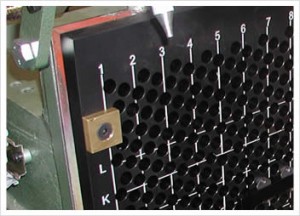 The lightweight grid-etched toggle base enables the operator to quickly and accurately align the die(s) on the toggle base during make-ready. The laser-etched grid is labelled numerically on the horizontal axis, and alphabetically on the vertical axis. The grid is replicated on the platen.
To facilitate make-ready further, press operators benefit from the light weight of this model. Weighing only 14lbs compared to the 40lb standard toggle base, less effort is required to mount the toggle base to the press.
Download the lightweight toggle base flyer for additional information.
- Greeting Cards
- Letterheads/Stationary
- Holograms
- Announcements
- Pocket Folders
- Report Covers
- Paperback/Case bound Book Covers
- Security Printing
- Labels
- Packaging
- Business Cards
- Die Cutting/Kiss Cutting
| EHD Series | English | Metric |
| Platen size | 14″ x 22″ | 356 x 559 mm |
| Minimum sheet size | 4″ x 5″ | 102 x 127 mm |
| Maximum sheet size* | 17″ x 24.75″ | 431 x 628 mm |
| Magazine Capacity | 14″” | 356 mm |
| Delivery Capacity | 14″ | 356 mm |
| Air | 90 psi @ 10cfm | |
| Stock range | Onion Skin to .200″ board | |
| Inside Chase Dimensions | 14″ x 22″ | 356 x 559 mm |
| Outside Chase Dimensions | 16.25″ x 23.5″ | 413 x 597 mm |
| Main and Back Shaft Diameter | 4.375″ | 111 mm |
| Maximum operating speed | 3,300 iph | |
| Machine power required | 3 h.p., A.C. 230/460 volt, 3 phase, 1800 rpm, 60 cycle | |
| Machine dimensions | 74″ x 50″ x 68″ | 1880 x 1270 x 1727 mm |
| Net weight (approx.) | 4400 lbs | 1996 kg |
| Total weight (approx.) | 5000 lbs | 2268 kg |
*Delayed Delivery is now standard on new EHD presses allowing for sheet sizes greater than 14″. The optional Wide Magazine upgrade increases the maximum sheet width to 26.25″.
Download product literature for the EHD Series Press.
EHD and EHF Series brochure (820kb)
EHD & EHF Series Press Rebuild Program
EHD Series Press Safety Upgrade Booklet
FSEA – The Designer’s Guide to Foil Stamping & Embossing
The User’s Guide to Hologram Stamping
Stages in the Make-Ready Process – Reference Guide (1.5mb)
Embossing and Foil Stamping: Techniques Made Easy – Reference Guide (2.8mb)
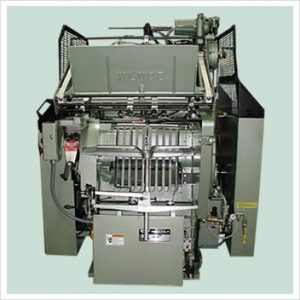
What’s the Difference Between an EHD and an EHF?
In general, the Kluge EHF Series Press has many more standard features than the EHD Series. This gives the EHF greater and more efficient foil stamping, embossing & die cutting capabilities on both short and long run print jobs.
The table below provides an overview of the differences between the EHD and EHF Presses.
Contact Kluge for further information on these presses.
| Feature | EHD | EHF | ||
| Standard | Option | Standard | Option | |
| Wide Magazine | X | X | ||
| Pre-load Magazine | X | X | ||
| Delayed Delivery | X | X | ||
| Two-up Feeding | X | X | ||
| Missed Sheet Detector | X | X | ||
| Filler Plate | X | X | ||
| Micro-Adjustable Bottom Gauge Band | X | X | ||
| Mechanical Jogger | X | X | ||
| Variable Speed Control | X | X | ||
| Electronic Foil Control System | X | X | ||
| Dual Foil Rewind | X | N/A | N/A | |
| Foil Detector | X | X | ||
| Hologram Registration | X | X | ||
| Grid Etched Lightweight Toggle Base | X | X | ||
| Overdrive | X | X | ||
| Adjustable Impression | X | X | ||
| Lockout Delayed Dwell system | X | X | ||
| Reversible Register Cam | X | X |